Certificate Attestation in Hyderabad: Understanding Document Authentication
Understanding Certificate Attestation in Hyderabad for Overseas Documents
An Indian certificate may be valid for use within the country but require additional authentication before it can be presented to a foreign university, employer, government department or other institution. This is because the receiving organisation may need confirmation that the signature, seal or official capacity associated with the document is genuine.
However, not every document follows the same procedure. The process can vary according to the certificate’s issuing authority, document category, destination country and intended purpose. Understanding these differences helps applicants prepare their paperwork correctly and avoid following an unsuitable authentication route.
This article explains the principles behind document authentication, the difference between apostille and attestation, and the checks applicants should make before using Indian documents abroad.
What Is Document Authentication?
Document authentication is a process used to establish the authenticity of an official signature, seal or other relevant formal element on a document. It helps the receiving authority assess whether the document has passed through the authentication procedure applicable to its intended use.
For example, a university qualification may need authentication before it is submitted to an overseas employer. A birth certificate may require authentication for a family-related administrative process, while a commercial document may need a different procedure for an international business transaction.
Authentication should not be confused with verification of every statement contained in a certificate. India’s Ministry of External Affairs (MEA) explains that its attestation or apostille concerns the signature of the designated authority and does not make the Ministry responsible for the document’s contents.
Therefore, applicants should distinguish between verifying the information contained in the original document and authenticating the official signature or seal associated with it.
Why Do Different Documents Follow Different Procedures?
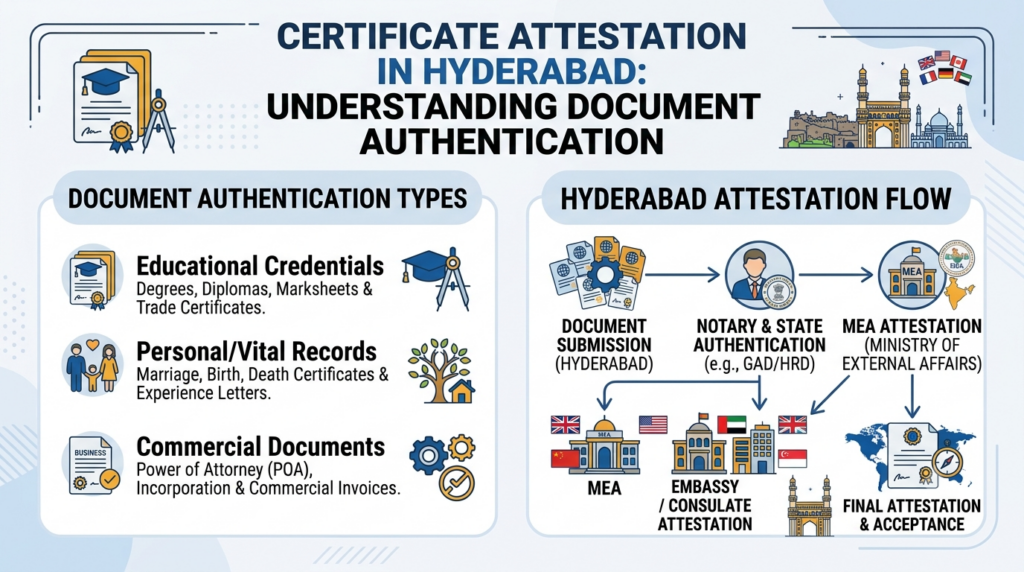
The procedure is influenced by the nature of the document and the authority that issued it. Educational qualifications, civil records and commercial paperwork are produced under different administrative systems, so their preliminary verification requirements may differ.
Educational documents
Educational documents can include degree certificates, diplomas, school certificates, marksheets and academic transcripts. Depending on the document and its intended use, verification by the issuing institution or the competent education authority may be required before further authentication.
Applicants should also check whether the receiving institution requires an original certificate, supporting academic records or additional evidence of the qualification.
Personal documents
Personal documents include birth certificates, marriage certificates, affidavits and certain other civil or legal records. The applicable preliminary authentication route depends on the document and the authority responsible for issuing it.
A certificate issued by one state authority may not follow exactly the same preliminary process as a document issued by another authority. This is why applicants should identify the document’s origin before relying on general instructions.
Commercial documents
Commercial documents are used for business, trade and other corporate purposes. Their authentication may involve a chamber of commerce or another competent authority, depending on the document and the requirements of the destination.
Commercial paperwork should therefore be assessed separately from educational and personal records.
Apostille and Attestation: Understanding the Difference
Apostille and normal attestation are two distinct forms of authentication used for documents intended for international use. The appropriate option depends on the destination country, the type of document and the applicable requirements.
According to the Ministry of External Affairs, India participates in the Hague Apostille Convention. Apostille is used for eligible public documents intended for countries where the Convention applies. Normal attestation is used where apostille is not the applicable route.
The practical distinction is important:
- Apostille: Authentication under the applicable Convention framework for eligible public documents.
- Normal attestation: An authentication procedure used where apostille is not the applicable route.
- Additional requirements: A receiving institution or destination authority may specify other documentary requirements, so applicants should confirm the complete process rather than rely on the authentication label alone.
Neither option should be selected solely because it appears simpler. The destination’s requirements must be checked first.
How Preliminary Verification Fits Into the Process
Before MEA authentication, some documents need to be authenticated by a designated state or other competent authority. The appropriate authority depends on the document category and applicable procedure.
For example, educational records may require verification through the relevant education authority, personal documents may require a designated state authority, and commercial records may involve a chamber of commerce.
The MEA outlines the applicable procedure on its official website. Applicants should consult the current instructions because routes and document-specific requirements can differ.
Consider an applicant who has a university degree issued in one state but now lives elsewhere. The applicant’s current residence alone may not determine the correct preliminary verification route. The issuing institution, document origin and applicable authentication requirements must also be considered.
Understanding this distinction before submitting a document can help prevent an applicant from starting with an authority that cannot process that particular record.
Why Destination Country Requirements Matter
Authentication is not a universal process that produces the same result for every country. A document intended for one destination may require a different route from a document intended for another.
The receiving organisation may also have requirements beyond authentication. A university could request transcripts, an employer could ask for a particular qualification record, and a government department could specify a prescribed document format.
Applicants should confirm the requirements with the organisation that will receive the certificate. This is especially important when a document is being prepared for employment, education, immigration or family-related formalities.
Example: Documents Intended for the UAE
For documents intended for the United Arab Emirates, applicants need to check the applicable Indian authentication stages and the relevant UAE attestation requirements. Eligible Indian-issued documents may be processed through the UAE’s official digital attestation service, subject to current rules and document eligibility.
When researching certificate attestation in hyderabad for uae, applicants should first establish whether the document is educational, personal or commercial, where it was issued and what the receiving organisation requires. These details help determine the appropriate route; the process should not be assumed to be identical for every certificate.
Common Misunderstandings About Document Authentication
Several misconceptions can lead to unnecessary work or incorrect expectations.
Assuming apostille and attestation are interchangeable
They serve different purposes within the applicable international authentication framework. Applicants should confirm which procedure is accepted for the destination and document.
Assuming authentication verifies all the information in a certificate
Authentication generally concerns the origin of the official signature, seal or capacity covered by the procedure. It does not automatically correct errors or guarantee acceptance for every purpose.
Assuming every certificate requires the same supporting records
The necessary documents can vary by issuing authority, document category and intended use. A general checklist may not cover every situation.
Assuming authentication guarantees acceptance by the receiving organisation
Authentication does not replace the receiving organisation’s own eligibility, qualification or documentary requirements. A properly authenticated certificate may still need to satisfy other conditions.
Relying on outdated instructions
Administrative procedures can change. Applicants should check official sources before submission instead of relying solely on old articles, informal advice or another person’s experience.
A Practical Checklist Before Submitting Documents
Before starting an authentication process, applicants can work through the following checks:
- Identify the exact document and the authority that issued it.
- Confirm the country and organisation where the document will be used.
- Ask the receiving organisation whether it requires apostille, normal attestation or additional authentication.
- Check whether preliminary verification is required.
- Confirm whether the original document, identification or supporting records are needed.
- Review the document for missing information, damage or inconsistencies.
- Check current official instructions before submitting paperwork.
These checks do not replace the formal procedure, but they help applicants understand what needs to be established before an application begins.
Understanding the Requirements Before Taking the Next Step
Document authentication is best approached as a document-specific process rather than a single sequence applicable to every certificate. The issuing authority, document category, destination country and intended use all influence which requirements need to be checked.
For people researching certificate attestation in hyderabad, the most useful first step is to identify the document and destination, then consult the relevant official guidance. This makes it easier to understand the distinction between verification, apostille and normal attestation before proceeding.
For additional information about document authentication services, readers can visit the Talent Attestation website. Relevant service information can help readers identify where to enquire further, while official government sources remain the reference point for current authentication rules.
By understanding the purpose of each authentication stage, applicants can make more informed decisions about preparing Indian certificates for use abroad.