Certificate Attestation in Chennai: Understanding Document Authentication for Overseas Use
Certificate Attestation in Chennai for UAE: Understanding Document Requirements
Indian certificates are often required for overseas employment, higher education, family-related formalities and other official purposes. Before these documents can be used in another country, the receiving organisation may require authentication to confirm the validity of the official signatures or seals associated with them.
However, document authentication is not a single procedure that applies to every certificate. Requirements can vary according to the document’s category, the authority that issued it, the country where it will be presented and the purpose for which it is needed.
Understanding these differences is particularly important when preparing Indian documents for the United Arab Emirates (UAE). Knowing how verification, attestation and apostille differ can help applicants identify the relevant requirements before submitting their documents.
What Does Document Authentication Establish?
Document authentication helps a receiving authority establish the authenticity of an official signature, seal or capacity associated with a document. It is different from checking whether every statement or qualification mentioned in the document is factually correct.
For example, an overseas university may require authentication of an academic certificate before accepting it as part of an application. A government department may request an authenticated birth or marriage certificate for an administrative procedure.
India’s Ministry of External Affairs (MEA) provides attestation and apostille services for eligible documents intended for use abroad. Its authentication process relies on the signature of the designated authority and does not establish responsibility for the document’s contents.
This distinction explains why an applicant may need to address two separate matters: whether the original document is valid and whether it has completed the authentication procedure required by the destination.
Why Document Categories Matter
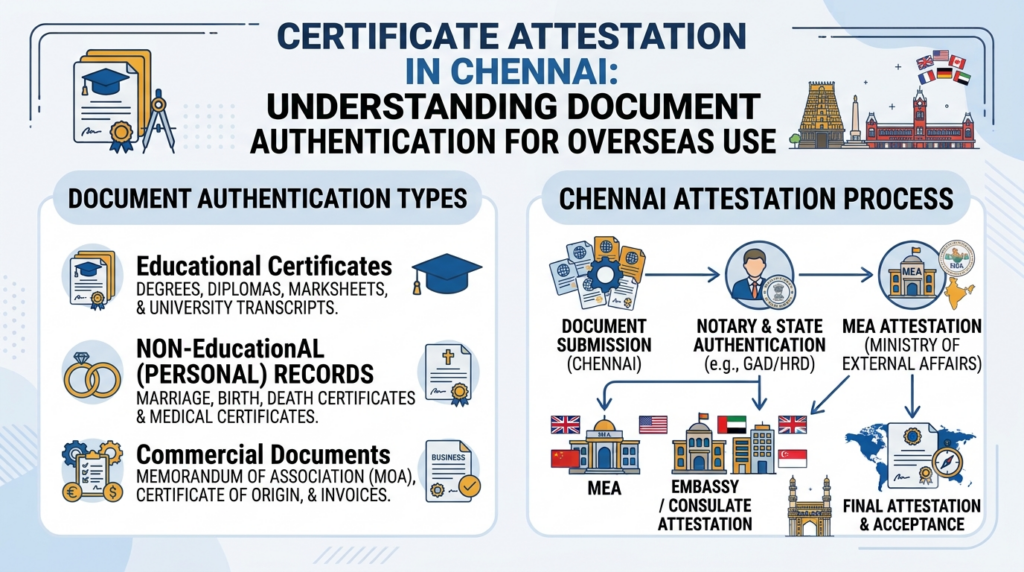
Educational, personal and commercial documents can follow different verification procedures. Identifying the category at the beginning helps applicants understand which requirements need to be checked.
Educational certificates
Educational documents include degree certificates, diplomas, school certificates, marksheets and academic transcripts. These records may be required for employment, further education or professional purposes abroad.
Depending on the document and the applicable procedure, preliminary verification by the issuing institution or competent education authority may be necessary. The receiving organisation may also request supporting academic records in addition to the main certificate.
Applicants should confirm which records are required rather than assume that authenticating one document automatically covers every related qualification.
Personal documents
Personal documents include birth certificates, marriage certificates, affidavits and other civil or legal records. Their authentication requirements can depend on the issuing authority and intended use.
For example, a certificate used for a family-related administrative process may be subject to requirements different from those for an educational qualification. Supporting identification or other records may also be requested.
Checking the issuing authority and the document’s physical condition before submission can help identify potential issues early.
Commercial documents
Commercial documents are used for business, trade and corporate transactions. Depending on the document, preliminary authentication may involve a chamber of commerce or another competent authority.
Commercial records should be assessed separately from educational and personal documents because their verification and submission requirements may differ.
How Indian Authentication Procedures Work
The authentication process can involve more than one authority. Some documents require preliminary verification by a designated state or other competent authority before they can proceed to MEA attestation or apostille.
The relevant authority depends on the document category and the applicable procedure. Educational records, personal certificates and commercial documents should not automatically be treated as following the same sequence.
Applicants should also distinguish between apostille and normal attestation. According to the MEA’s official guidance, apostille is used for eligible documents intended for countries where the Hague Apostille Convention applies. Normal attestation is used for destinations where apostille is not accepted.
The receiving country’s requirements should determine the appropriate route. Choosing a procedure simply because it is commonly used for another destination can lead to unnecessary steps.
What Makes UAE Document Requirements Different?
Documents intended for the UAE must meet the applicable Indian authentication requirements and the UAE’s rules for attestation. The precise procedure depends on the type and origin of the document, as well as the requirements of the organisation receiving it.
For eligible Indian-issued documents, the UAE Ministry of Foreign Affairs offers a digital attestation service. Its official guidance states that Indian documents must first be attested by India’s MEA before proceeding through the relevant UAE service.
When researching certificate attestation in chennai for uae, applicants should establish which document needs authentication, where it was issued and what the receiving organisation requires. These details help determine which stages apply to the specific document.
The UAE’s official guidance also distinguishes between different types of records. For instance, official personal documents such as birth and marriage certificates are subject to original-document requirements under the cited service guidance, while commercial invoices and certificates of origin follow a separate submission route.
Applicants should review the latest requirements directly through the UAE Ministry of Foreign Affairs before submitting documents. Eligibility and procedural details should be confirmed rather than inferred from another applicant’s experience.
Apostille Versus UAE Attestation
Apostille and embassy-related attestation serve different purposes within the applicable international authentication framework. An apostille is not automatically a substitute for the UAE-specific attestation required for an Indian document intended for use in the UAE.
The correct process depends on the destination and the receiving authority’s requirements. Applicants should not assume that an apostille alone satisfies every UAE document requirement.
Before beginning, check whether the receiving organisation specifies a particular authentication sequence, supporting record or document format. Where instructions are unclear, consult the relevant official authority instead of relying on a general checklist.
Common Misunderstandings About Authentication
Several assumptions can create confusion when preparing documents for overseas use.
Authentication verifies every detail in the document
Authentication generally concerns the official signature, seal or capacity covered by the procedure. It does not automatically correct errors in a certificate or confirm every statement it contains.
All certificates follow the same procedure
The requirements for educational, personal and commercial documents may differ. The issuing authority and document category should be established before deciding which steps apply.
Apostille is accepted for every destination
Apostille is used under the applicable Convention framework. Other destinations may require normal attestation or a different authentication route.
An authenticated document is guaranteed acceptance
Authentication does not replace the receiving organisation’s own requirements. A university, employer or government department may still require additional records or impose separate eligibility conditions.
Old instructions always remain valid
Administrative requirements can change. Applicants should check current official guidance before submitting original documents or relying on previously published processing instructions.
Preparing Documents Before Submission
Although the authentication route varies, several preliminary checks are useful across many document categories.
- Identify the document and the authority that issued it.
- Confirm the destination country and the purpose of submission.
- Check the receiving organisation’s documentary requirements.
- Establish whether preliminary verification is necessary.
- Confirm whether originals, supporting records or translations are required.
- Check that the certificate is legible and that its details are consistent with relevant records.
- Consult official guidance for the applicable authentication procedure.
These checks cannot replace the formal requirements of the relevant authorities, but they help applicants understand what needs to be established before proceeding.
Understanding the Requirements for Documents Issued in Chennai
The place where an applicant currently lives does not necessarily determine the authentication route. The document’s issuing authority, origin and destination requirements may also affect which preliminary steps are necessary.
For anyone researching certificate attestation in chennai, the most useful starting point is to identify the certificate, establish where it will be used and consult the applicable official instructions. This approach helps distinguish document verification from apostille and embassy-related attestation.
Talent Attestation publishes information about document authentication and services for overseas use through its official website. Readers can consult the relevant service information for further context, while the MEA and UAE Ministry of Foreign Affairs remain important references for official procedural requirements.
Ultimately, understanding the purpose of each authentication stage helps applicants prepare Indian documents more carefully and avoid assuming that one procedure applies to every certificate or destination.